I’m obsessed with time. It, not money, is my most coveted resource.
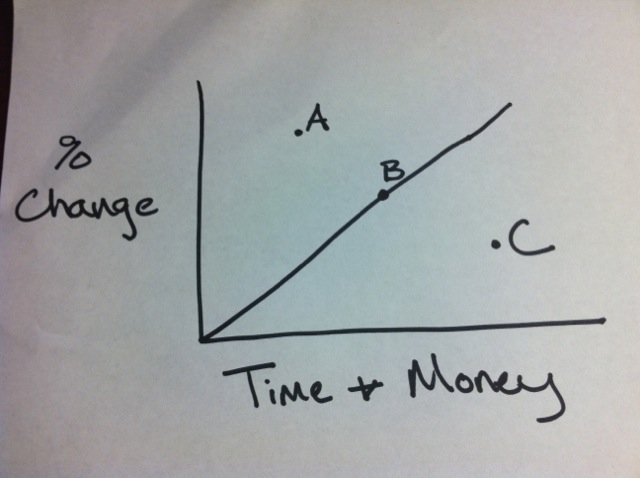
A caveat is that the two often work hand-in-hand. More money often affords you the ability to spend more time on other things you care about. But spending less time on something can provide additional time to accumulate more money doing something else. These two things (time & money) on one axis and % change on another serves as my go-to-guide for determining the value of a task prior to participating.
As far back as I can remember I’ve always stringently evaluated how much time I spent performing a task or learning something new. Ultimately, I always want to conclude before I start, “Will this be worth it?”
Let’s look at a real life example:
The Tutoring Dilemma
My freshman year of college there were 4 upperclassmen who wanted me to tutor them in Economics so that they could pass the class and remain on the baseball team. My options were:
- A.) Tutor them individually once a week 2 hours at a time. This would probably enable them to learn the material the best, but that’s 8 hours out of my week, each week for the duration of the class.
- B.) Tutor all of them together at the same time 2 hours a week. For this scenario they would get less individual attention, but I’m investing 2 hours of my week as opposed to 8 hours of my week.
- C.) As part of my own study process I could create a study guide detailing very thorough ways for solving every kind of problem, and provide them with it. This took quite a bit of time, but I was doing it for myself anyway, and sharing it with the 4 of them. It took 0 additional hours out of my weekly schedule.
Which scenario do you think I did?
You might’ve guessed C, but you’d be wrong. Let’s see why…
Though the % increase of possibly earning an A was relatively high, it would’ve been a huge time investment for me. Option C would not have cost me any additional time, but the likelihood that the guys understood the material enough to pass wouldn’t be very high either. And we needed those guys.
Option B made the most sense because I only had to invest 2 hours each week, the guys learned the material well enough to earn a passing grade, and we kept our teammates for the duration of the season.
[Note: Above options do not correspond with data points in image below.]
Here’s the image I always refer to in my head when I’m trying to evaluate whether or not I should perform a task:

If spending 20 hours learning to speed read enables me to consume significantly more content throughout the duration of my life that could easily represent point A, yes?
If a $400 pitching wedge enables me to shave 4 strokes off my golf game, it won’t make me Tiger Woods, but it wasn’t a huge investment either. A new pitching wedge could be point B.
If learning Japanese takes me 2 years and I don’t know anyone who is Japanese and it doesn’t help me progress my chosen career, maybe that could be point C.
If you plot your imaginary point and it’s above the diagonal line, you should do it, but if it’s below you should typically refrain.
It’s so simple and yet so many people fail to look critically at their decisions. If Dave in IT can use Photoshop to make that photo look 96% better in 30 minutes for $25 bucks, is it worth it to hire Mark at Agency X to make it look 98% better in 15 minutes for $300 bucks?
The answer is that it most likely depends on what you’re trying to accomplish, and what kind of resources (i.e. how much time and money you can devote to the project) you have. For the vast majority of projects, Dave’s solution probably makes the most sense, but for a select few Mark might be the answer.
What do you think? How do you weigh your decisions? Do you think this model would work for you?
You are a perfect example of Homo Economicus.
As a Econ major myself I typically make decisions based off of opportunity cost, which is basically what you described in your post.
Indeed. I’m pretty subjective (see: logical. Ha!) in most of my decisions, and I was definitely an Econ fan in school even though I didn’t take too many classes. I’m significantly more Homo Economicus — there’s rarely anything cooperative about my motivations.